
Natural Ways to Increase HGH: What the Science Actually Supports
Growth hormone naturally declines with age – by some estimates, total daily HGH secretion drops two- to threefold between your 30s and 40s alone [1]. Before looking at any supplement, it’s worth knowing that a handful of everyday factors have real, well-documented effects on how much growth hormone your body produces on its own. Here’s what the research actually supports, in order of how strong the evidence is.
1. Prioritize Deep Sleep
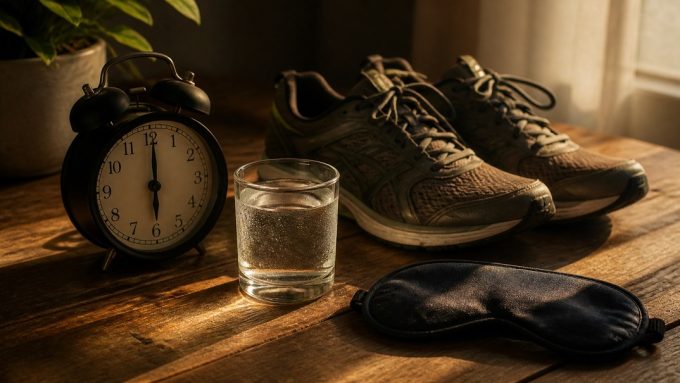
This is the single biggest lever you have. In adults, the most reliable and largest pulse of growth hormone release happens shortly after you fall asleep, tied to the first period of slow-wave sleep – the deepest stage of non-REM sleep [1]. In men, roughly 70% of nighttime GH pulses coincide with this stage [1], and studies enhancing slow-wave sleep experimentally have shown a corresponding jump in GH release [2].
What this means practically: protecting your first sleep cycle matters more than almost anything else on this list. That means a consistent bedtime, a dark and cool room, and avoiding the two things known to specifically disrupt this window: alcohol and late, heavy meals (more on both below). If sleep quality itself is your main concern, we go deeper on the sleep-hormone connection here: GABA, Sleep, and Growth Hormone.
2. Do High-Intensity Exercise
Exercise is a well-established stimulus for GH release, and the effect is dose-dependent on intensity rather than duration. One controlled study found that GH secretion increased in a roughly linear fashion as exercise intensity rose from below to well above the lactate threshold – the point at which exercise starts to feel noticeably harder and less sustainable [3]. Other research places the effective intensity threshold at above the lactate threshold, sustained for at least around 10 minutes, as the point that reliably triggers a meaningful GH response [4].
What this means practically: short, hard efforts – think interval training, or resistance training pushed close to fatigue – appear to be more effective for this specific purpose than long, easy cardio. This lines up with why interval-style training shows up so often in general fitness advice, independent of the HGH angle specifically.
3. Consider Fasting or Time-Restricted Eating
Fasting is one of the most consistently documented triggers for increased GH secretion in clinical research. A controlled study found that a 72-hour fast produced roughly a threefold increase in GH secretion compared to the fed state [5], and earlier research found that even a two-day fast significantly increased both the frequency and amplitude of GH secretory bursts in healthy men [6].
What this means practically: it’s worth being precise here – the strongest evidence comes from fasting periods of two to three full days, which isn’t the same thing as a daily 16:8 time-restricted eating window. Shorter fasting windows are generally assumed to produce a smaller version of the same effect, but there’s less direct research specifically measuring that. If you’re interested in fasting for this reason, it’s a conversation worth having with a doctor first, particularly if you have any blood sugar, metabolic, or eating-related health considerations.
4. Manage Body Composition, Especially Visceral Fat
This one works in the opposite direction from the others: carrying excess visceral (abdominal) fat is strongly associated with blunted GH secretion. Research has found that both spontaneous, resting GH release and the GH response to exercise are measurably impaired in people with significant abdominal fat accumulation compared with people of a healthier body composition [7].
What this means practically: of everything on this list, this is the one that works as a long-term foundation rather than a daily habit – reducing visceral fat through diet and consistent exercise over time appears to remove a real brake on your body’s natural GH output.
5. Limit Alcohol, Especially in the Hours Before Bed
This is one of the more dramatic and consistently replicated findings in this area, and it’s rarely mentioned in general HGH advice. A classic controlled study found that alcohol suppressed nighttime plasma GH levels by 70 to 75%, an effect seen on both single-night and repeated-night alcohol use [8]. A separate study found a similar dose-dependent suppression, with GH nearly completely blocked at a higher alcohol dose taken in the evening [9].
What this means practically: if you’re taking sleep and exercise seriously for this purpose, evening alcohol is working directly against both, by disrupting the sleep architecture that GH release depends on.
6. Watch Blood Sugar, Particularly Before Bed
Elevated blood glucose suppresses GH secretion, while low blood glucose stimulates it – this relationship is well established enough that an oral glucose tolerance test is used clinically to help diagnose GH-related conditions, precisely because it reliably suppresses GH in healthy people [10].
What this means practically: a large, high-sugar or high-refined-carbohydrate meal close to bedtime works against the natural sleep-onset GH pulse described above, for the same underlying reason exercise and fasting help it.
Putting It Together
None of these factors require a supplement, and none of them are secret – but taken together, they represent a more powerful and better-researched lever over your body’s own growth hormone production than any pill on the market. Consistent deep sleep, intense (not necessarily long) exercise, a healthy body composition, and limiting late alcohol and heavy sugar intake in the evening cover the fundamentals the research actually supports.
Where does a supplement like an HGH releaser fit in, if at all? At most, as a complementary addition on top of these fundamentals, not a substitute for them – no HGH releaser supplement has research showing an effect anywhere close to what’s been measured for fasting, exercise, or sleep architecture. If you’re curious how a specific product’s ingredients hold up against the kind of research cited on this page, our GenF20 Plus review covers exactly that, and our breakdown of HGH releasers vs. peptides vs. prescription HGH covers where supplements sit relative to more medically intensive options.
Frequently Asked Questions
What is the single most effective natural way to increase HGH?
Deep, uninterrupted sleep has the strongest and most consistent research behind it. The largest, most reliable GH pulse in adults occurs during the first period of slow-wave sleep early in the night.
Does exercise really increase HGH?
Yes, and the effect is intensity-dependent: GH release increases roughly in proportion to how far above your lactate threshold you’re working, so shorter, harder efforts tend to produce a bigger response than longer, easier ones.
Does fasting increase growth hormone?
Yes. Controlled studies show fasting periods of about two to three days significantly increase GH secretion. Shorter fasting windows are thought to produce a smaller effect, though there’s less direct research on those shorter periods specifically.
Can supplements replace these natural methods?
No. No HGH releaser supplement has research showing an effect close to what’s documented for sleep, exercise, or fasting. Supplements are best thought of as a possible complement, not a substitute.
Sources
- “Physiology of growth hormone secretion during sleep.” PubMed
- “Hypnotic enhancement of slow-wave sleep increases sleep-associated hormone secretion and reduces sympathetic predominance in healthy humans.” Communications Biology. PMC
- “Impact of acute exercise intensity on pulsatile growth hormone release in men.” Journal of Applied Physiology. Journal of Applied Physiology
- “The exercise-induced growth hormone response in athletes.” PubMed
- “Exercise and Fasting Activate Growth Hormone-Dependent Myocellular Signal Transducer and Activator of Transcription-5b Phosphorylation and Insulin-Like Growth Factor-I Messenger Ribonucleic Acid Expression in Humans.” Journal of Clinical Endocrinology & Metabolism. Oxford Academic
- Hartman ML, et al. “Augmented growth hormone (GH) secretory burst frequency and amplitude mediate enhanced GH secretion during a two-day fast in normal men.” Journal of Clinical Endocrinology & Metabolism, 1992 (cited via subsequent literature). Journal of Applied Physiology (citing study)
- “4 weeks of high-intensity interval training does not alter the exercise-induced growth hormone response in sedentary men” (background review of visceral fat and GH secretion). PMC
- Prinz PN, et al. “Effect of Alcohol on Sleep and Nighttime Plasma Growth Hormone and Cortisol Concentrations.” Journal of Clinical Endocrinology & Metabolism, 1980. PubMed
- “Ethanol decreases nocturnal plasma levels of thyrotropin and growth hormone but not those of thyroid hormones or prolactin in man.” PubMed
- “Comparison of oral versus intravenous glucose exposure on plasma growth hormone levels: a crossover study in healthy volunteers.” PMC
This article is for informational and educational purposes only and is not medical advice. Consult a healthcare provider before making significant changes to your diet, exercise routine, alcohol use, or fasting practices, particularly if you have any existing health condition.
Comments are closed.