
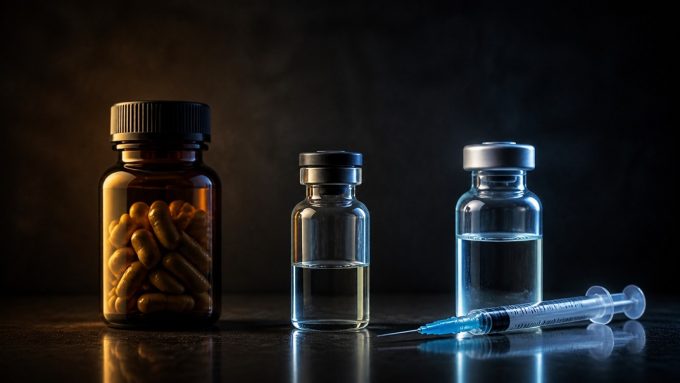
HGH Releasers vs. Peptides vs. Prescription HGH: What’s the Difference?

Search around for ways to increase growth hormone and you’ll run into three very different categories of product, often described with overlapping language that makes them sound more similar than they are. Here’s a clear, neutral breakdown of what separates an over-the-counter HGH releaser, a growth hormone secretagogue peptide, and prescription HGH (somatropin) – including the legal status of each, since that’s the part most comparisons skip.
At a Glance
| HGH Releaser Supplements | GH Secretagogue Peptides | Prescription HGH (Somatropin) | |
|---|---|---|---|
| What it is | Amino acid / herbal / glandular blend, taken orally | Compounds like MK-677, CJC-1295, ipamorelin, sermorelin that stimulate the pituitary directly | Synthetic version of the hormone itself, injected |
| How you get it | Purchased directly online, no prescription | Gray-market “research chemical” sales, or compounding pharmacies via telehealth prescription | Licensed physician prescription only, for a diagnosed condition |
| Legal status (U.S.) | Legal, regulated as a dietary supplement under DSHEA | Not FDA-approved for human use; several restricted from compounding; legal gray area for personal purchase [1] | Legal only for FDA-approved conditions with a valid prescription; distributing or prescribing for anti-aging/performance use is a federal crime [2] |
| WADA / sports status | Generally not prohibited by name, though quality/contamination risk exists | Prohibited at all times under WADA category S2 [3] | Prohibited at all times under WADA category S2 [3] |
| Typical monthly cost | Roughly $30–$70 | Roughly $100–$400+, depending on source and protocol | Often $1,000+ per month |
| Strength of evidence | Weak to modest; most ingredients dosed below their research levels | Moderate; measurable GH/IGF-1 effects in trials, but limited long-term safety data | Strong for its approved medical uses; not studied or approved for anti-aging in healthy adults |
HGH Releaser Supplements
This is the category products like GenF20 Plus belong to: oral supplements combining amino acids (like L-arginine and L-glutamine), herbal extracts (like tribulus terrestris), and sometimes glandular ingredients, sold as dietary supplements without a prescription. They’re regulated under the Dietary Supplement Health and Education Act (DSHEA), which means no FDA pre-market approval is required, and it’s on the manufacturer to ensure safety and truthful labeling rather than proving efficacy before sale.
The evidence picture here is generally the weakest of the three categories. Many of the individual ingredients have real research behind them, but usually at doses well above what a typical blend actually contains – we cover this in detail for one specific product in our ingredient dose comparison. The upside is accessibility and a generally low risk profile: no prescription, no injections, and a much lower side-effect burden than the other two categories.
Growth Hormone Secretagogue Peptides
This category includes compounds like MK-677 (ibutamoren), CJC-1295, ipamorelin, GHRP-2, GHRP-6, and sermorelin. Unlike the amino acids in a releaser supplement, these are purpose-built pharmacological compounds that directly stimulate the pituitary gland’s growth hormone release, either by mimicking the hormone ghrelin or by acting on growth hormone-releasing hormone receptors.
The legal and regulatory picture is genuinely complicated. Most of these compounds are not FDA-approved for any use, and are commonly sold labeled “for research purposes only” or “not for human consumption” – labeling that doesn’t make selling them for human use legal [1]. In 2023, the FDA placed a number of these peptides on a restricted “Category 2” compounding list, limiting compounding pharmacies’ ability to legally prepare them, though this status has continued to shift under regulatory review [4]. A growing number of telehealth clinics now prescribe some of these peptides off-label through licensed compounding pharmacies, which is a meaningfully different (and more regulated) path than buying an unlabeled vial online, but it still isn’t the same as an FDA-approved use. Nearly all growth hormone secretagogue peptides, MK-677 included, are prohibited at all times for athletes under WADA’s Prohibited List [3].
The evidence for these compounds is more substantial than for oral releaser supplements – clinical trials have measured real increases in GH and IGF-1 – but long-term safety data in healthy adults remains limited, and reported side effects include increased appetite, water retention, and effects on blood sugar and insulin sensitivity that warrant monitoring [5].
Prescription HGH (Somatropin)
This is synthetic human growth hormone itself, administered by injection, and it’s the most tightly regulated of the three categories. The FDA has approved somatropin for a specific, limited list of conditions: pediatric and adult growth hormone deficiency, Turner syndrome, Prader-Willi syndrome, chronic renal insufficiency, short bowel syndrome, HIV/AIDS-associated wasting, idiopathic short stature, SHOX deficiency, and Noonan syndrome [6]. It is not approved for anti-aging use, athletic performance, or general wellness in otherwise healthy adults, at any age.
The legal restriction here is unusually strict compared to most prescription drugs. Under 21 U.S.C. § 333(e), it’s a federal crime to distribute HGH, or possess it with intent to distribute, for any use other than a recognized medical condition – and the FDA has stated that writing a prescription for an unauthorized use can itself count as unlawful distribution under this statute [2]. Penalties can include up to five years in federal prison and a $250,000 fine, rising to ten years if a minor is involved [7]. In other words: even with a willing doctor, prescribing HGH specifically for anti-aging purposes is not a legal gray area the way peptides are – it’s explicitly prohibited.
For patients who do have an FDA-approved indication, prescription HGH is administered under close physician supervision with regular bloodwork, since side effects can include fluid retention, joint pain, carpal tunnel syndrome, and elevated blood sugar, and dosing is titrated to keep IGF-1 within a safe, age-appropriate range [8].
Where This Leaves You
Think of these three categories less as competing options and more as a spectrum of accessibility, evidence, potency, and risk moving in the same direction: HGH releaser supplements are the most accessible, cheapest, and lowest-risk, but also carry the weakest evidence. Peptides sit in the middle – a real pharmacological effect with real research behind it, but a complicated legal landscape and meaningfully less long-term safety data than an approved drug. Prescription HGH is the most potent and best-studied option for its approved medical uses, but it’s also the most tightly restricted, by far the most expensive, and explicitly illegal to obtain for anti-aging or performance purposes, regardless of how willing a provider might seem.
If you’re the kind of person who wants a supported, cautious starting point, the foundational lifestyle factors covered in our guide to natural ways to increase HGH carry no legal or regulatory complications at all, and in several cases have stronger research behind them than any product in this comparison. If you’re specifically weighing an HGH releaser supplement, our GenF20 Plus review covers where that specific product fits into this picture.
Frequently Asked Questions
What’s the difference between an HGH releaser and a peptide?
HGH releaser supplements are OTC amino acid/herbal blends sold as dietary supplements with no prescription required. GH secretagogue peptides directly stimulate the pituitary gland, aren’t FDA-approved for general use, and are typically sold as unregulated research chemicals or obtained via compounding pharmacies.
Is it legal to buy prescription HGH for anti-aging purposes?
No. Under 21 U.S.C. § 333(e), distributing HGH for anything other than an FDA-approved medical condition is a federal crime, and the FDA has said this can include writing a prescription for an unauthorized use. Anti-aging is not an approved indication.
Are growth hormone peptides like MK-677 legal?
It’s a gray area. Most are not FDA-approved for any use and are sold “not for human consumption,” which doesn’t make human-use sales legal. Several are also on WADA’s Prohibited List and have faced compounding pharmacy restrictions.
Which option actually raises growth hormone the most?
Prescription HGH has the most direct, best-documented effect since it’s the hormone itself. Peptides show real measured effects in trials. HGH releaser supplements have the weakest evidence, since most ingredients are dosed below their research levels.
Sources
- “Is Buying Human Growth Hormone Online Legal?” LegalClarity
- “Can Anti-Aging Doctors Prescribe Human Growth Hormone as Elixir of Youth?” (quoting FDA’s written interpretation of 21 U.S.C. § 333(e)). Medical Justice
- “Performance Enhancing Substance: MK-677 (Ibutamoren).” Operation Supplement Safety (OPSS), U.S. Department of Defense–supported resource
- “Is Buying Human Growth Hormone Online Legal?” (2023 FDA compounding restriction list). LegalClarity
- “MK-677 (Ibutamoren): Evidence & Legal Status.” Peptide Clinic Finder (industry-adjacent resource, cited for its summary of reported side effects; cross-check against a clinician for current guidance)
- “Somatropin (Recombinant Human Growth Hormone, rhGH, HGH).” Peptide List (summary of FDA-approved indications)
- “Is HGH a Controlled Substance? Penalties and Legal Uses.” LegalClarity
- “Somatropin (Recombinant Human Growth Hormone, rhGH, HGH)” (dosing/monitoring and side-effect profile). Peptide List
This article is for general informational purposes only and is not legal or medical advice. Laws and regulations governing HGH, growth hormone secretagogues, and dietary supplements can change and vary by jurisdiction; consult a licensed attorney for legal questions and a healthcare provider before considering any of these categories for personal use.


Comments are closed.